March 7 In an interview with Human Rights Watch, the New York based human rights group, Rosemary Nelson reports that a number of her clients recently released from Gough Barracks in Armagh complained of death threats issued by interviewing detectives against her. Clients were told that Rosemary's photo and personal details would be passed on to loyalists. In addition to the death threats, officers are reported to have made inappropriate and insulting sexual comments. Four months earlier, in December 1996, a Lawyers Committee for Human Rights report, (At the Crossroads: Human Rights and the Northern Ireland Peace Process, p133 ) called on the British Government to "require vigorous and independent investigation of all threats to legal counsel in Northern Ireland. Solicitors who report threats of violence should be accorded effective protection."
May 8 Following the death of Portadown man Robert Hamill the family solicitor, Rosemary Nelson, announces her intention to take legal action against those RUC officers who refused to intervene and prevent the attack that led to the death. The solicitor also vows to gain access to video tapes from cameras overlooking the scene of the assault. (Three weeks before her death Rosemary Nelson informs the Pat Finucane Centre that the RUC had refused to allow her access to the tapes.)
July 5 As the legal representative for the residents in the area, Rosemary Nelson is present when an Orange parade is forced through Garvaghy Road. After the RUC begin to move in, Mrs Nelson approaches RUC officers, identifies herself as the residents' lawyer, and asks for the commanding officer. A number of RUC officers then physically assault her, causing bruising to her arm and shoulder, and shout sectarian remarks at her. Because the officers involved were not wearing any identification numbers, Mrs Nelson asks for their names. They respond by telling her to "fuck off."
October 20-31 The United Nations (UN) Special Rapporteur on the Independence of Judges and Lawyers, Mr Param Cumaraswamy, undertakes a fact-finding mission to investigate allegations received concerning the harassment and intimidation of defence lawyers by officers of the Royal Ulster Constabulary (RUC). In his report Mr Param Cumaraswamy states, "There have been consistent reports of alleged systematic abuse of defence lawyers in Northern Ireland by certain RUC officers since 1992." Rosemary Nelson, although not named in the UN report, is one of a number of solicitors who was the subject of the UN investigation.
On October 24, Rosemary Nelson gives evidence to Mr Param Cumaraswamy.
Before publication of the final UN report, RUC Chief Constable Ronnie Flanagan is given a draft copy which contains the names of defence lawyers making the complaints about death threats, intimidation and harassment. Rosemary Nelson is one of the main complainants. Ronnie Flanagan is quoted in the UN report as saying that allegations concerning RUC intimidation and harassment of solicitors is part and parcel of a political agenda to portray the RUC as part of the unionist tradition. He also says that paramilitary organisations wanted to ensure that detainees remained silent during interrogation and accuses defence solicitors of conveying this message to their clients (Paragraph 21). Initially, Ronnie Flanagan denies making these claims. When notes taken by a UN assistant verify the comments, the Chief Constable then says he can not guarantee the safety of the lawyers who have already given evidence. The names of all the defence lawyers are removed from the final UN report.
Late 1997 After complaints laid by Rosemary Nelson, an Independent Commission for Police Complaints (ICPC) investigation begins into claims that RUC officers made death threats against Mrs Nelson. As with all ICPC investigations however it is RUC officers who are tasked to investigate other RUC officers.
1998
January 14 Rosemary Nelson is one of 33 lawyers to sign a petition calling for equal protection under the law. "We, the undersigned members of the legal profession in Northern Ireland, wish to express our grave concern at the failure of the rule of law and the relative immunity from prosecution of members of the security forces who have violated basic human rights and contravened national and international laws." (See Appendix A)
January 15 In a Channel 4 Dispatches TV documentary the UN Special Rapporteur, Mr Param Cumaraswamy, expresses particular concern for Rosemary Nelson's safety.
February Rosemary Nelson expresses her "outrage" at the arrest of the brother of Portadown murder victim Robert Hamill for questioning in connection with disturbances on the Garvaghy Road eight months beforehand.
March The report of the UN Rapporteur, Mr Param Cumaraswamy, is published. He concludes "that the RUC has engaged in activities which constitute intimidation, hindrance, harassment or improper interference". He records his particular concern "that the RUC has identified solicitors with their clients or their clients' causes as a result of discharging their functions".
After spending seven days being questioned in Castlereagh, a man informs his solicitor, Rosemary Nelson, that RUC detectives made obscene remarks about her and told him there had been a law enacted in 1989 to deal with solicitors who help their clients. Mrs Nelson replies by telling him that no such law exists. Recounting the incident to the Irish News, the man then said Mrs Nelson became alarmed, after realising the RUC men were allegedly referring to the death of murdered defence lawyer, Pat Finucane.
May According to a report in the Irish News, a legal row is set to break out over a decision not to hold an inquest on Co. Armagh republican Sam Marshall, murdered in controversial circumstances in 1990. Rosemary Nelson, the family's solicitor, says she intends to challenge the coroner's decision in the high court.
July 18 At a meeting in Armagh between the Garvaghy Road Residents Coalition (GRRC) and Jonathan Powell, Chief of Staff to PM Tony Blair, the issue of personal security for the delegation is raised. Rosemary Nelson, solicitor for the residents group, is a member of the delegation.
July 21 During a further bilateral with Mr Powell concerns are again raised regarding the personal security of the group. Specific mention is made of a leaflet circulating in the Portadown area which clearly threatened the personal security of Breandan Mc Cionnaith and Rosemary Nelson. According to the agreed minutes of the meeting an RUC Superintendent told Mr Mc Cionnaith that "all the RUC could provide was crime prevention advice". The minutes record the frustration of the GRRC delegation at the "dismissive" attitude of the RUC regarding death threats to the group. The Lurgan solicitor is present on both occasions when the issue is raised. A promise is made that officials from the Northern Ireland Office (NIO) will get back to the group within 48 hours.
July 23 A meeting takes place with two officials from the NIO and security measures are promised in respect of the two councillors. Rosemary Nelson is excluded from the scheme since she was not an elected official. This is despite the fact that she was mentioned in the leaflet referred to above and lived and worked in a more vulnerable environment ie outside of the Garvaghy Road . At further meetings with the NIO over the following months the issue of security is raised on a number of occasions. (Personal protection for the two councillors was finally put in place on the very weekend that the bomb was planted under Rosemary Nelson's car)
July The ICPC raises a number of "serious concerns" with Dr Mo Mowlam, Secretary of State, and Chief Constable, Ronnie Flanagan, over the RUC handling of its own investigation into death threats against Rosemary Nelson. As a result Commander Niall Mulvihill from the London Metropolitan Police is called in to replace the RUC and head his own investigation into the allegations of death threats.
September 29 Rosemary Nelson gives evidence to the International Operations and Human Rights Sub-committee of the US Congress. Rosemary highlights the difficulties facing lawyers including "RUC officers questioning my professional integrity, making allegations that I am a member of a paramilitary group and, at their most serious, making threats against my personal safety including death threats. All of these remarks have been made to my clients in my absence because lawyers in Northern Ireland are routinely excluded from interviews with clients detained in the holding centres." (See Appendix B)
1999
January 18
Rosemary Nelson accompanies the Garvaghy Road Resident Coalition to meet with British Prime Minister Tony Blair in London. The group presents the Prime Minister with a dossier outlining illegal Orange parades in the area and intimidation directed at the Garvaghy residents.
February 12 Rosemary Nelson addresses a Pat Finucane Centre benefit in Derry, marking the 10th anniversary of the murder of Pat Finucane. Over 1200 lawyers worldwide sign a petition published in the Irish Times and Irish News calling for an international independent inquiry into Pat Finucane's murder.
March 11 The Solicitors Criminal Bar Association, representing 50 legal firms, offers support to the judicial review that is examining the Law Society of Northern Ireland's decision not to allow its human rights committee to discuss the murder of defence solicitor Pat Finucane, one of the Law Society's former members.
March 15 The Irish News devotes a full page to the situation in Portadown with extensive coverage of comments by Rosemary Nelson criticising the inaction of the RUC in the face of continuing illegal loyalist protests. "Sight has been lost of the fact that there has been a legally binding decision made by the Parades Commission last year which clearly states that the Orange Order should disperse and not remain on the hill. The law has been flouted openly." The interview with Rosemary continues, "We do not have 'two sides equally intransigent', as is often said. We have a nationalist community trapped, living in a village on the edge of town. It is not about conflicting rights here, it is about the rule of law."
In a separate article, it emerges that the family of Portadown murder victim Robert Hamill is to forge closer links with the Lawrence family in England. Stephen Lawrence was killed in a racist attack in London in 1993. Commenting on the proposed cooperation Mrs Nelson, solicitor for the Hamill family says, "He…[Robert]...was targeted because he was a Catholic. We are seeing racism here, racism dressed up as sectarianism."
Hours after the interview is published Rosemary is murdered by a bomb placed under her car. A small loyalist splinter group, the Red Hand Defenders, claims the attack.
Many people are suspicious of these claims because of the sophisticated nature of the bomb. These suspicions are further fuelled by reports of a high level of RUC and military activity in the vicinity of Rosemary Nelson's home in the days and hours leading up to her murder. This begs the question how a small loyalist splinter group could have attached such a sophisticated device in a very exposed locality without coming to the attention of the security forces.
RUC Chief Constable Ronnie Flanagan calls in David Philips, Chief Constable of Kent, and John Guido of the FBI to oversee the RUC investigation into Rosemary Nelson's murder. It later transpires that it is not intended for either David Philips or John Guido to be in Northern Ireland on a daily or regular basis. This is not made clear when Mr Philips and the FBI are brought in as 'guarantors' of the investigation. Ronnie Flanagan continues to insist that the RUC will carry out the investigation. In light of the death threats Rosemary Nelson received and the circumstances surrounding her murder, local people indicate their fear and unwillingness to cooperate with any RUC investigation.
Congressman Chris Smith (New Jersey, USA), Chairman of a House panel which has been investigating the intimidation of defence solicitors in the north, describes the murder of Rosemary Nelson as a "gross atrocity" and challenges the Blair government to "follow every lead, even if it implicates security forces and the police".
Taoiseach Bertie Ahern refers to the "assassination of one of the leading people in the world of law." He says that the murder had sent "shock waves through the international community."
President Clinton says that the killing was "a despicable and cowardly act by the enemies of peace."
Craigavon Council adjourns its mid-monthly meeting as a mark of respect to murdered solicitor Rosemary Nelson.
Within an hour of Rosemary Nelson's death being confirmed, residents of the Nationalist Kilwilke estate in Lurgan march to the centre of the town. A minute's silence is held outside her office on William Street.
March 16 UN High Commissioner for Human Rights, Mary Robinson, says she is shocked and saddened by the death of such a courageous human rights lawyer, whose life had been repeatedly threatened. "Her death has sad echoes of the murder of Pat Finucane and comes at a particularly sensitive time in the peace process."
Minister for Foreign Affairs, David Andrews, confirms he has spoken to the Minister for Political Development in Northern Ireland, Mr Paul Murphy, to convey his deep concern at "this terrible event" and to stress the absolute importance of bringing those responsible to justice as speedily as possible.
Tony Blair states no effort would be spared in "hunting down" those responsible for the murder of Rosemary Nelson. Mr Blair condemns this "disgusting act of barbarity" and says her murderers wanted to remove any chance of reconciliation in Northern Ireland.
Ken Livingstone, Labour MP, says that he was planning to table an Early Day Motion in the House of Commons calling on the government to investigate what security measures were taken to protect Mrs Nelson's life.
Speaking from Washington, Ulster Unionist leader David Trimble, in whose constituency the murder took place, says he was "horrified" and extends sympathy to her family.
Seamus Mallon, also in Washington, says the killing "shows in a murderous and grotesque way how important the peace process is and that nothing must be allowed to endanger the cause of peace".
Sinn Féin president Gerry Adams, says he is shocked at the murder. "The attack on Rosemary Nelson is an attack on the Good Friday agreement which proclaims the right of citizens to live free from sectarian abuse".
Paul Murphy, Political Development Minister, says the attack was sinister, cowardly and despicable. "While it is too early to speculate on who was responsible for this horrific incident, we will leave no stone unturned in the effort to bring the perpetrators of this evil crime to justice."
Deputy leader of the Ulster Unionist Party, John Taylor, condemns the murder on behalf of the party "without reservation" and says the killing was wrong. "Whilst Unionists would have disagreed with Rosemary Nelson's views and actions, murder can never be condoned."
DUP leader. Ian Paisley, "unequivocally" denounces the attack. "A mother is dead and her children have been left without a mother."
Alliance Party deputy leader, Seamus Close, says those behind the attack wished to blow apart the prospects of peace and political stability.
Bríd Rodgers, the SDLP Assembly member for Upper Bann, commends Mrs Nelson for her work with the Garvaghy residents in Portadown and her representation of the family of Robert Hamill. "She defended the basic human rights of a vulnerable and exposed community."
Dara O'Hagan, Sinn Féin Assembly member and a friend of Rosemary Nelson's, claims there were those within the military establishment who were intent on silencing Rosemary Nelson. "This was an attack carried out by experienced people and was not the work of amateur loyalist groups."
The Women's Coalition urges people to line up behind Mrs Nelson's aspirations and ensure that her death reinforces "the principles of justice, by which she lived."
The CAJ calls for an independent investigation into the murder and says it would be "untenable" for the RUC to head the inquiry.
President of the Northern Ireland Law Society, Catherine Dixon, says the attack was cowardly and a blatant attempt to intimidate the profession. "Solicitors have worked over many years of the Troubles to provide the best possible service to the entire community."
Vigils and protests are held throughout the North and in London. Martin Finucane, brother of murdered Belfast solicitor Pat Finucane, describes as "pathetic and inept" the appointment of a senior English police officer to oversee the inquiry and states that only a full, international, independent inquiry into Rosemary Nelson's murder would be satisfactory.
Police Authority Chairman Pat Armstrong expresses "total outrage" over the murder of Rosemary Nelson. Mr Armstrong gives his "full backing" to Ronnie Flanagan's actions, "We would applaud the chief constable's speedy action in this matter and would give our full support to his decision."
March 17 Kent Chief Constable David Phillips, the English policeman appointed to oversee the investigation into Rosemary Nelson's murder, arrives in the North. The American Embassy in London confirms the FBI would also be meeting with the RUC after Chief Constable Ronnie Flanagan asked for assistance.
Frankie Curry, a member of the Red Hand Commandos, is shot dead in the Shankill Road area of Belfast. Speculation in the aftermath of the killing points the finger at the Ulster Volunteer Force, one of the larger loyalist paramilitary groups currently on ceasefire. Former UVF leader Gusty Spence, uncle of the murdered man, denied the claims.
Brice Dickson, Chief Commissioner of the recently formed Northern Ireland Human Rights Commission, says "The Human Rights Commission believes that allegations of collusion between the RUC and paramilitaries can be effectively and credibly investigated only by officers from outside the RUC."
Gerry Adams states "clearly this mechanism of appointing English policemen to get at the truth will find no support or confidence among nationalists."
Bríd Rodgers states, "I am concerned about the independence of the investigation…I think the primary investigators should be an outside police force and that the role of the RUC in this should be very much secondary."
Candlelit vigil is held outside the British consulate in New York to protest against the murder.
Garvaghy Road residents' spokesman Breandan MacCionnaith attacks Tony Blair over the murder of Rosemary Nelson. Mr MacCionnaith, addressing a protest outside the RUC station in Lurgan, tells the crowd that requests for protection for Rosemary Nelson had been made to Mr Blair's chief of staff, Jonathan Powell, but were ignored. The Northern Ireland Office confirms that third party approaches had been made about Rosemary Nelson's safety, but says she had never approached the government herself.
March 18 Funeral of Rosemary Nelson takes place. Several thousand mourners follow the cortege from the Nelson home to St. Peter's Church.
Following the funeral, leading English barrister, Michael Mansfield, calls for an independent investigation and a judicial inquiry into the murder.
The SDLP Assembly group calls for an independent inquiry into Rosemary Nelson's murder.
The Irish News reports that the completed investigation into claims RUC officers issued death threats against Rosemary Nelson will not be made public on March 19, despite hopes that it was poised for release. The Irish News reports that details behind the decision to pull the RUC off the case last year are likely to emerge. It emerges that the removal of the RUC from the investigation was initiated by the ICPC. While Chief Constable Ronnie Flanagan pointed out earlier this week that he had introduced a replacement team from the Metropolitan Police Force to investigate the death threat allegations, the decision came after an ICPC recommendation that RUC investigators be replaced.
In a number of interviews in Washington, David Trimble raises the possibility that the bomb may not have been planted by loyalists. Mr Trimble specifically says that the effect of the murder was so favourable to republicans that it might have been carried out with the aid of republicans.
March 19 RUC Chief Constable, Ronnie Flanagan, issues a press release expressing his deep appreciation of both the Kent Constabulary and the FBI for their involvement in the investigation into the murder of Rosemary Nelson. Mr Flanagan emphasises that no constraint or limit whatever will be placed upon them as they pursue their determination to "ensure and to demonstrate honesty of purpose, professionalism and integrity in this investigation". The Chief Constable also announces that the British Irish Rights Watch document into the murder of Pat Finucane, recently presented to the Secretary of State, has been referred by him to Mr John Stevens, Deputy Commissioner of the London Metropolitan Police Service, for investigation. In a statement, the Pat Finucane Centre condemns the decision. According to a spokesperson, John Stevens is the "last person" who should be invited in to investigate the murder of Pat Finucane given the totally unsatisfactory outcome of Stevens' previous investigations into allegations of collusion.
Amnesty International expresses its misgivings that the investigation would not be "sufficiently independent" and calls for the British government to set up an independent judicial inquiry into allegations that security forces have "systematically" harassed defence lawyers in the north of Ireland.
At a press conference, the ICPC announces that in the year 1998 alone, 15 different solicitors, including Rosemary Nelson, made a total of 36 complaints about RUC behaviour towards them. However Peter Madden, partner of the late defence lawyer Pat Finucane, claims that the numbers are unrepresentative. When he and his colleagues have been harassed they have chosen to report the incidents to British Irish Rights Watch instead of the RUC.
The ICPC also verifies that after "serious concerns" arose about the RUC's handling of Mrs Nelson's complaints of harassment, the RUC team involved was replaced by members of the London Metropolitan Police Force. While supervising the RUC's handling of Rosemary Nelson's complaints of harassment, the ICPC expressed concern to Chief Constable Ronnie Flanagan and Northern Secretary Mo Mowlan over the handling of the case. This was the first instance in which the ICPC referred a case to the Northern Secretary.
As the ICPC press conference is taking place Kent Chief Constable David Phillips and John Guido of the FBI issue a press statement. In the statement the two outside officers claim that they will "provide independent and professional scrutiny" of the RUC murder investigation and express the view that the investigation will only be successful if carried out by the RUC. It remains unclear how they came to this conclusion given that they had by this stage spent less than 48 hours in the North. The statement is seen as an attempt at damage limitation timed as it was to coincide with the ICPC press conference.
In reply, Sinn Féin spokesperson Bairbre de Brún asks, "The ICPC adjudged the RUC incapable of investigating threats against Rosemary Nelson's life. How can Mr Phillips (of the Kent Constabulary) judge them capable of investigating her murder?" SDLP member Bríd Rogers agrees. "The SDLP is appalled by this declaration in the appropriateness of the RUC investigating the murder of Rosemary Nelson. One has to ask how such a statement could be made on the same day as the ICPC reports on the fact that it doubted the RUC's handling of Rosemary Nelson's allegations of police harassment to the extent that it referred the claims to the Metropolitan Police."
Chairman of the Northern Ireland Police Authority Pat Armstrong views the criticism of the RUC differently. "It is hard to escape the conclusion that some of the recent commentators are not interested in securing the detection of Mrs Nelson's murderers, but are using her murder as a platform from which to attack the RUC."
The Ulster Democratic Party refuses to be drawn on reports suggesting UDA/UFF involvement in murder of Rosemary Nelson.
March 20 Further vigils held in England and Ireland.
March 21 Ireland on Sunday carries reports that individuals with valuable evidence in the murder of Rosemary Nelson will not speak to the RUC. The report refers to two potential witnesses who are adamant that they will not cooperate with the RUC, although they would be willing to give evidence to an independent inquiry. Newspaper reports link dissident elements of mainstream loyalist groups to Rosemary Nelson's murder.
March 22 Sinn Féin urges an end to unrest in Lurgan following a weekend that saw continued violence in the town. Sinn Féin Upper Bann Assembly member Dara O'Hagan also demands the withdrawal of the "provocative" RUC presence from the Kilwilke area. Irish News reports that the SDLP is to raise concerns that the RUC officers alleged to have issued death threats against Rosemary Nelson have not been suspended.
SDLP assembly member Bríd Rodgers calls for Tony Blair to agree with the Taoiseach in the view that any inquiry into the murder of Rosemary Nelson would have to involve an independent team of investigators. Ms Rodgers calls for UN Special Rapporteur Param Cumaraswamy to be fully involved in the inquiry and for the RUC to be removed from the inquiry into Rosemary Nelson's murder.
March 23 The ICPC gives the Nelson family a copy of its report detailing its "serious concerns" surrounding the original RUC investigation into death threats against Rosemary Nelson. Her husband, Paul, in calling for the investigation of his wife's murder to be undertaken by police officers from outside the RUC, states, "If the ICPC had no confidence in the ability of the RUC to investigate the death threats against Rosemary how can my family be expected to have confidence in their ability or indeed their willingness to effectively investigate her murder?" (See Appendix C)
Taoiseach Bertie Ahern reiterates his stance that the investigation into the murder of Rosemary Nelson should be "independent and transparent" and that the English officer leading the investigation should be in total control.
March 24 Representatives of the Pat Finucane Centre are asked to visit Lurgan to take statements from people who may wish to provide information about the murder of Rosemary Nelson. The initiative is intended to ensure that evidence is gathered while it is still fresh and is not intended as an alternative investigation.
Newspaper appeal by RUC for information regarding the murder of Rosemary Nelson.
The ICPC report, printed in the Irish News, lists 16 "serious concerns" which the ICPC Supervising Officer had with the RUC investigation into death threats against Rosemary Nelson. These include claims that RUC officers were hostile, evasive, disinterested and uncooperative and that a senior RUC officer made judgements about Mrs Nelson's character and cast doubt on her professional integrity. The report also comments on "the ill disguised hostility to Mrs Nelson on the part of some police officers".
Solicitors throughout the North compile a petition calling for the RUC to be withdrawn from the investigation into the murder of Rosemary Nelson. One hundred and ninety eight solicitors eventually add their names to the petition.
The British government rejects calls to pull all RUC officers off the investigation into the murder. NIO Minister Lord Dubs says the RUC is best qualified to carry out the murder hunt.
Senior Ulster Unionist Michael McGimpsey supports RUC involvement in the murder inquiry and rejects claims of RUC collusion with the group which claimed the murder.
March 25 It is reported that none of the RUC officers who were the subject of ICPC concerns has faced disciplinary action. Defending his decision not to suspend the officers involved the RUC Chief Constable says, "Those officers have rights just in the way that everyone else has rights." His response avoided the central issue; suspension is a normal course of action where serious charges are levelled in any accountable organisation and should not imply guilt though it appears to in Ronnie Flanagan's opinion.
March 26 The London Metropolitan Police supervised investigation into the death threats to Rosemary Nelson is being considered by the DPP. The report also contains a review of the conduct of the original RUC investigation team. Despite the seriousness of the concerns detailed by the ICPC, no formal investigation has been carried out into the behaviour of the original RUC investigation team.
According to press reports, FBI agents carry out their first interviews with potential witnesses in the Rosemary Nelson murder case. However, no one in Lurgan can confirm that the FBI carried out any interviews with witnesses.
An editorial in the Church of Ireland Gazette criticises Ulster Unionist John Taylor as "disingenuous" for his comments in blaming the murder on "misguided" loyalists who justified their actions in the fact that the IRA refuses to disarm. The editorial goes on to link the murder to the ongoing controversy at Drumcree saying, "Tears must be shed for the Church of Ireland too, for we cannot refuse to accept that this woman might still be alive today but for the events connected with our church at Drumcree".
March 27 Over 130 groups in the community and voluntary sector publish an advertisement in the Irish News calling for an independent investigation and inquiry. Cearta, the group coordinating the initiative, calls for faxes to be sent to the British Prime Minister and the Irish Taoiseach.
On the same day, the Irish News reports that the widow of a loyalist murder victim is to lodge a complaint against the RUC over its handling of the murder investigation. Speaking after the inquest the family of John McColgan, murdered in January 1998, says that "absolutely nothing" was being done about the murder. They ask why the RUC took so long to arrive at the scene, failed to set up roadblocks despite the fact that the killers were driving the victim's car, and, contrary to the RUC' s claim, had not contacted the family for over a year.
March 28 Several hundred attend a vigil in memory of Rosemary Nelson at Belfast City Hall, organised by Cearta. The newspaper Ireland on Sunday reports that senior members of the RUC tried to improperly influence the ICPC report into how the RUC handled abuse and death threats made against Rosemary Nelson. According to legal sources, RUC officers tried, over several months, to persuade the ICPC to "tone down" and leave out some of the many criticisms. The article also reports on UN Special Rapporteur Mr Param Cumaraswamy's follow-up report which is strongly critical of both the British government and RUC. The second UN report accuses the RUC of showing "complete indifference" to allegations of threats made against defence solicitors, one of whom was Rosemary Nelson. The report is particularly critical in one section of RUC Chief Constable, Ronnie Flanagan, accusing him of "allowing the situation to deteriorate".
During an interview on BBC Radio Ulster, Catholic primate of all-Ireland, Archbishop Sean Brady calls for an independent investigation. He says, "I would prefer to see the United Nations Special Rapporteur involved. I think it is important that it inspires confidence and I think it may be better if the RUC were out of the investigation altogether. They may have to provide back-up."
March 29 Under growing pressure, the Deputy Chief Constable of Norfolk, Colin Port, is called in to assume "day-to-day control, direction and command" of the murder investigation but the Chief Constable, Ronnie Flanagan, continues to insist that the RUC will undertake the investigation. Colin Port was previously part of UN international investigation teams in Yugoslavia and Rwanda which were carried out without any local input. This supports the claim that a totally independent investigation could be successfully carried out.
March 30 Chief Constable, Ronnie Flanagan, and ICPC Chairman, Paul Donnelly, issue a joint statement in relation to the investigation of death threats against Rosemary Nelson. A ten page summary is published contemporaneously by Commander Mulvihill of his view of ICPC concerns into the original RUC investigation. Nationalist parties and human rights' groups brand the Mulvihill review an "exercise in damage limitation". It is seen by many informed observers as an attempt to discredit the ICPC report. Reacting to the Mulvihill response Brid Rodgers of the SDLP calls on the Chief Constable Ronnie Flanagan "to accept the reality that the assessment of an independent supervisor from the ICPC is more objective and more credible in the eyes of the community than that of a policeman".
March 31 In a letter to members of the Law Society, President Catherine Dixon explains that the Council decided to remain "neutral... (i.e. not to vote for or against a judicial inquiry)" into the death of Pat Finucane because "it was argued that it was best that the Council should remain neutral on this issue, as to do otherwise might be divisive of the profession as a whole..." In her own words, Mrs Dixon believes that such a decision "may have served perhaps to demonstrate the wisdom of the Council's non-aligned policy." She continues, "Over the past thirty years, despite the fact that the profession is made up of many different shades of opinion and political allegiance, we have successfully remained united in a commitment to provision of impartial independent legal advice to all of the community." Many solicitors are angered by the refusal of the Law Society to take a position on the issue of an independent inquiry.
April 3 The Andersonstown News reveals that appeals for information issued by the inquiry team into the murder of Rosemary Nelson contained wrong dates and phone numbers. The RUC faxed an appeal for information about the movements of cars and vans in the Lurgan area before Rosemary Nelson's murder to media outlets across the north with an incorrect date for the day before Rosemary's death. On ringing to check the details an Andersonstown News reporter got a BT message to say the number no longer existed.
April 12 Mr Param Cumaraswamy presents his report to the UN Commission on Human Rights which claims "prima facie evidence" of military and/or RUC collusion in Pat Finucane's murder. He also states that the RUC displayed "complete indifference" towards solicitors' complaints of RUC harassment. RUC Chief Constable Ronnie Flanagan responds, "I reject the notion that we are indifferent. We are not indifferent. I take, and this organisation takes, any complaint very seriously indeed." He then continues by stating that he has introduced audio-recording of RUC interviews and has requested input from the Law Society into how the RUC can be "fully sensitive to the role of defence lawyers." Police Authority Chairman Pat Armstrong defends Ronnie Flanagan by rejecting Mr Param Cumaraswamy's claims of RUC indifference.
Bríd Rogers, SDLP assembly member asks, "How many more internationally respected figures have to investigate his force before Mr Flanagan takes on board their criticism and does something to address their concerns?"
Also reacting to Mr Param Cumaraswamy's report, Martin O'Brien of the Committee on the Administration of Justice says, "For a country which purports to uphold the rule of law and to have an international reputation for doing so, it is impossible the government won't now establish an inquiry."
On the same morning as Mr Param Cumaraswamy delivers his report to the UN the RUC hold their first press conference with Colin Port, deputy Chief Constable of Norfolk and John Guido the FBI legal attaché. Deputy Chief Constable Port calls for members of the community to come forward with information and warns that the investigation would be "severely handicapped" if the RUC was excluded. He adds, "I am aware of reports that some members of the community who may have crucial information have made statements and disclosures to a number of organisations but who have been reluctant to contact the police." John Guido, speaking for the FBI team involved in the investigation, states that "Frankly, we found the RUC to be well prepared to handle this investigation and we found little that we suggest they change or do differently." The strategy whereby outside police officers praise the RUC at key moments (during the ICPC press conference and the UN hearings in Geneva) raises questions about the media role of those who are intended to provide a neutral element to the investigation.
April 13 RUC confirms that the investigation team consists of 40 RUC officers and 10 English officers and says that the involvement of outside investigators is "increasing everyday". Still left unclear is whether or not Chief Constable of Kent David Phillips and members of the FBI are included in this number.
April 14 In a letter to the British Secretary of State, Dr Mo Mowlam, the Irish Junior Minister of State for Foreign Affairs, Liz O' Donnell, urges the British Government to set up a public inquiry into the 1989 murder of Belfast solicitor Pat Finucane.
Meanwhile, the House International Relations Committee of the US Congress passes a motion cutting off funding for joint RUC/FBI training programmes until such time as independent investigations into the murders of Pat Finucane and Rosemary Nelson are instituted. (See Appendix D)
Dr Mo Mowlan meets with Mr Param Cumaraswamy, UN Special Rapporteur. After the meeting 'both sides agreed to keep in contact'.
April 15 The European Parliament passes a motion calling for an independent investigation and judicial inquiry into Rosemary Nelson's murder. (See Appendix E) One month after the murder, memorial services are held in Ireland, the US, Australia, Canada, South Africa and Britain.
The Law Society of Upper Canada, the Canadian Bar Association, the Advocates' Society, the Criminal Lawyers' Association, and the Law Union of Ontario all call for an independent, international inquiry into Rosemary's murder.
April 16 Security minister Adam Ingram defends the RUC by saying that the Chief Constable has gone to "unprecedented lengths" to address public concerns, and says that RUC involvement in the Nelson case is essential if the murderers are to be caught.
UN Special Rapporteur Param Cumaraswamy meets with Chris Patten of the Independent Commission into Policing.
April 19 Rosemary Nelson Campaign launched in Belfast. The group seeks an independent investigation of Mrs Nelson's murder and a wider judicial inquiry into the circumstances surrounding her death. Spokesperson Dr Robbie McVeigh emphasises that the group's aim is the defence of human rights, an important issue for all communities. "The murder of Rosemary Nelson was of course a terrible event with potentially huge implications for policing and human rights in the north of Ireland." With reference to the RUC he says, "Justice must be done and must be seen to be done in this case. If the RUC or other security forces were involved in collusion in the murder then this must be exposed. If not they have nothing to fear from an independent investigation and indeed should welcome it." British human rights lawyer Gareth Pierce attends the press conference and comments on the risk taken by human rights lawyers, "For that lawyer to be subjected to threats or far, far worse a risk of assassination is terrifying and destabilising."
April 20 Paul Nelson accepts a Times/JUSTICE legal award on behalf of his wife Rosemary. Sponsored by the Times of London and the human rights group JUSTICE, the award recognises lawyers who have made significant contributions to human rights.
The US House of Representatives votes for a resolution calling for an investigation, independent of the RUC, into the deaths of both Rosemary Nelson and Pat Finucane. It also demands that an independent judicial inquiry investigate defence attorneys' claims of harassment and intimidation by security forces. In Congressman Chris Smith's words, "For far too long, the people of Northern Ireland have lived in fear of their own police force. It is incumbent on that force to step aside from this investigation, and allow a fair and impartial investigation, if for no other reason to prove that they have nothing to hide."
According to a BBC Spotlight programme, the explosives used in the bomb that killed Rosemary Nelson was not powergel as previously thought. The programme also claims that the Red Hand Defenders and the Orange Volunteers are one and the same. With respect to the investigation team into the murder, Spotlight says that there are six constabularies from England now involved.
April 21
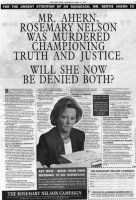 In a full page advertisement in the Irish Times, the Rosemary Nelson Campaign address an open letter to Bertie Ahern. In the letter, the campaign calls for the Taoiseach "in deed and word" to support an independent and international judicial inquiry into Rosemary Nelson's murder. There is also a coupon for people to cut out and send to the Taoiseach.
Taoiseach Bertie Ahern tells the Daíl that he believes Rosemary Nelson's allegations of intimidation and harassment by RUC members "are of more than merit". He expresses concern about the reluctance of some witnesses to give information and he raises the issue as to whether or not the RUC is capable of conducting an impartial investigation. "We have to try to negotiate with the British government and be satisfied - which we are not yet, but I hope we will be - that the investigation is operated in such a way that all potential witnesses can with confidence come forward. If we can achieve that I will be happy - if we can't then we will have to look further."
April 22 US Congressman Ben Gilman, Chair of the House International Relations Committee, holds hearings on the RUC. Rosemary Nelson was due to give evidence at this congressional hearing. Diane Hamill, sister of murdered Portadown man Robert Hamill, gives testimony and Dr Robbie McVeigh of the Rosemary Nelson Campaign attends the hearings. A statement from Paul Nelson is read into the Congressional Record. (See Appendix F for the full text of Paul Nelson's submission.)
April 25 According to a report in the Sunday Times, a newspaper close to the thinking of the security services, the Nelson inquiry team intends to interview both the pilots and crew of British Army helicopters which were on surveillance duties in the skies above North Lurgan on the night the explosive device was planted. Colin Port, deputy Chief Constable of Norfolk is quoted, "There were helicopters up in the sky. We are interviewing their pilots, the people who were with them, who do include Royal Irish Regiment people. We are looking at the whole security force activity during the relevant hours." He continued, "So far I have found nothing to suggest that police collusion would have been required to carry out this murder. But the collusion aspect of the investigation is continuing and it is a wide-ranging investigation that covers all aspects of security force work."
Ireland on Sunday reports that Edmund Lynch, US national coordinator of the Lawyers Alliance for Justice in Ireland, has compiled a list of letters and meetings that raised concerns about Rosemary Nelson's safety beginning in March 1993. The four page document reveals how many times senior British ministers and the RUC were warned about threats to Mrs Nelson's life and when concerns were passed onto members of the United States Congress. It highlights the fact that no member of the RUC has ever been arrested or suspended for derogatory behaviour toward Mrs Nelson and questions the reliability of any investigation of allegations of misconduct against members of the RUC conducted by British police officers.
The newspaper also reports that more English constables will be joining the murder investigation, but that Britain's Northern Ireland Security Minister Adam Ingram has ruled out removing the RUC.
The Dublin based Sunday Business Post also reports that two associates of loyalist Frankie Curry are now suspects in the murder investigation. According to a source the Post describes as close to the investigation, Curry, killed two days after Rosemary Nelson, is likely to be identified as the source of the bomb and the one who arranged to have one of the two suspects collect the device in Bangor. However, due to the fact that Curry was an intelligence source for E department, the RUC Special Branch, the Sunday Business Post believes that it is likely the RUC will refuse to release the file on grounds of security, thereby ending the trail of the Rosemary Nelson murder investigation.
Special Agent John Guido tells the paper that the FBI team he heads will be withdrawing from the investigation and will only return if invited by Ronnie Flanagan.
May 1 The Irish News reports that 20 members of the Northern Ireland Law Society have signed a petition calling for the resignation of the Society's Council after it refused to endorse an independent inquiry into the murder of former member Pat Finucane. The 20 member group also calls for the Society to accept a demand for an independent inquiry and investigation into the death of Rosemary Nelson.
In an interview with the Irish News, Colin Port says he maintains "regular contact" with both Chief Constable David Philips and John Guido of the FBI whom he describes as "advisers".
The investigative team now includes 40 RUC members as well as 19 English staff. However, Mr Port says that the number of English officers "fluctuates".
He also says that the investigation covers four main areas: forensics, collusion, intelligence and general matters. Surprisingly, regarding the matter of collusion, Mr Port says the team is not composed of English officers, but RUC. "It actually is RUC people, because they know the systems that operate here and that's what is absolutely crucial. I know that some of your readers might find that strange, but they [RUC officers] are the people who actually know how security forces work. And, of course, one of the things I am also doing in my review of the process is reviewing the collusion investigation. I have some people actually reviewing it even at this stage and those people reviewing it are from non-RUC forces. So we've got the basic information from the RUC, but then we're sort of looking at it in depth." Mr Port also notes that the RUC officers on the team "in the main, are not from Lurgan, are from other areas of Northern Ireland, but they know the systems. They know the jargon." Overall, the collusion team is "two to one" RUC, but Mr Port notes this "fluctuates" as well. He also describes Ronnie Flanagan's decision to set up the collusion unit on the first day as "very wise".
Mr Port also tells the Irish News that he has already been afforded access to intelligence files and is confident the he will continue to be given access to everything he requests.
Colin Port dismisses newspaper reports that Frankie Curry orchestrated the murder and was also an intelligence agent; however, the Irish News points out to Mr Port that Frankie Curry's murder has been considered by the investigative team.
Mr Port concludes by saying, ""I would say that this investigation is independent because I'm heading it - I am independent. And no one will interfere with my progress on this... I'm appointed by the chief constable, my report will go to the director of public prosecutions, but ultimately I am responsible to the rule of law. That is what it is all about."
Previous Section Next Section
Introduction